


For years, chemical supply chains were built around one primary question: How quickly can cargo move through ports and across global transport networks?
Today, a different question is becoming more important:
How resilient is your supply chain once cargo has arrived in Europe?
Recent disruptions have shown that the biggest supply chain risks often emerge after products reach the continent. Delayed vessels, customs inspections, sudden capacity shortages, regulatory changes, and shifting customer demand require companies to react quickly. Increasingly, the ability to respond depends not on port infrastructure itself, but on the logistics network behind it.
For chemical companies, where product availability, safety compliance, and operational continuity are critical, modern hinterland logistics has become a strategic advantage rather than a supporting function.
Why the Focus Is Moving Inland
Over the last few years, supply chain priorities have shifted dramatically. While efficiency remains important, resilience has become a boardroom topic.
The Red Sea crisis, recurring port congestion, geopolitical uncertainty, infrastructure bottlenecks, and labor shortages have exposed the vulnerability of highly optimized supply chains. At the same time, regulatory requirements continue to expand. New frameworks such as ICS2, CBAM, evolving dangerous goods regulations, and stricter customs controls are creating additional complexity across international trade.
For chemical logistics, these challenges carry even greater consequences than in many other industries: while a delayed consumer product may cause inconvenience, a delayed chemical raw material can bring an entire production line to a standstill.
As a result, many companies are rethinking how inventory is positioned across Europe. The objective is no longer simply moving cargo quickly but ensuring products remain available when disruptions occur.
This is where strategically located hinterland facilities are becoming increasingly important. They provide:
- Multiple options for standardized and customized value-added services to make most out of the products while they’re in storage
- Buffer capacity during transport disruptions
- Faster access to regional markets
- Greater flexibility for inventory positioning
- Improved compliance management
- Alternative routing options when transport conditions change
In short, resilience is increasingly determined by where inventory is stored and how quickly it can be redeployed.
Contract Logistics Has Become a Strategic Function
Modern warehousing is no longer about storing pallets. Today's Contract Logistics facilities operate as integrated logistics platforms that combine inventory management, transportation coordination, compliance support, and value-added services within a single operation. For chemical companies, this evolution is particularly significant. Inventory is no longer viewed merely as stock. It has become a strategic risk-management tool.
When disruptions occur, companies with inventory positioned close to customers gain valuable response time. They can adapt transport plans, prioritize shipments, and maintain service levels while competitors wait for supply chains to recover.
Effective Contract Logistics supports this by combining:
- Real-time inventory visibility
- Flexible storage concepts
- Transportation coordination
- Dangerous goods expertise
- Regulatory compliance management
The choice between dedicated and multi-user facilities further increases flexibility. Dedicated warehouses allow highly customized operating environments, while multi-user concepts provide scalable capacity without major fixed investments.
However, in chemical logistics, infrastructure alone is not enough. Dangerous goods storage requires certified processes, highly trained personnel, advanced safety systems, and continuous regulatory oversight. Managing substances with specific storage requirements, water hazard classifications, or battery-related risks demands expertise that goes well beyond conventional warehousing capabilities.
The real value therefore lies in the combination of infrastructure, compliance expertise, operational know-how, and visibility.
Flexibility Requires More Than Inventory
Knowing where inventory is located is only part of the challenge. The more important question is: How quickly can companies move that inventory when circumstances change? This is where Less than Container Load (LCL) and consolidation services are becoming increasingly relevant.
Traditional logistics models often require companies to wait until enough cargo is available to justify full-container movements. In today's volatile market environment, that can create unnecessary delays and inventory risks. LCL solutions provide an alternative.
By allowing businesses to move smaller shipment volumes aligned with actual demand, LCL offers several advantages:
- More responsive replenishment cycles
- Reduced inventory exposure
- Improved working capital efficiency
- Greater flexibility during market fluctuations
Consolidation adds another layer of resilience. Combining multiple shipments into efficient transport flows improves container utilization while reducing inefficiencies across the network. For chemical products, however, consolidation requires specialist expertise. Dangerous goods regulations, segregation requirements, carrier restrictions, and documentation obligations leave little room for error. As a result, successful consolidation depends as much on operational competence as on physical infrastructure.
Where Resilience Becomes Operational Reality
Many logistics providers offer warehousing. Others provide transport services. The real resilience advantage emerges when both capabilities are integrated into one coordinated network.
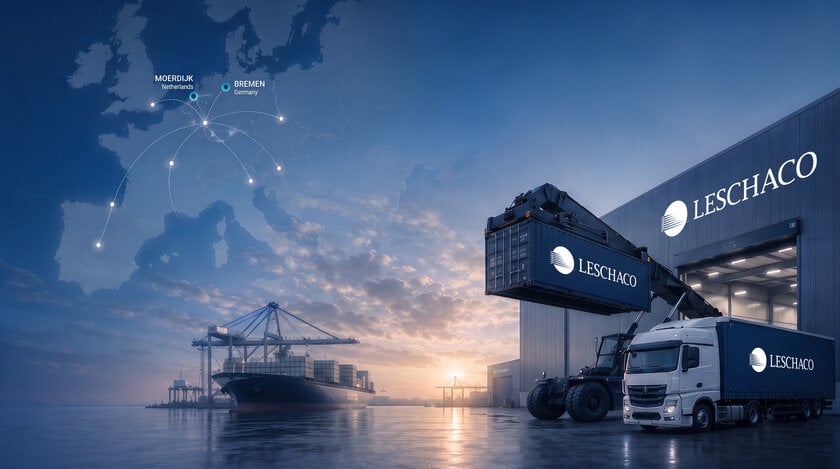
This is precisely the principle behind Leschaco's chemical logistics facilities in Bremen and Moerdijk. Both locations have been designed to connect Contract Logistics, dangerous goods handling, warehousing, distribution, and multimodal transportation within a single logistics ecosystem.
Bremen: A Strategic European Chemical Logistics Hub
Bremen serves as a central hub for chemical logistics and LCL operations within the European network.
The new multi-purpose chemical logistics center combines:
- Dangerous goods warehousing
- Contract Logistics services
- Container Freight Station operations
- Packing and value-added services
- LCL consolidation expertise
With approximately 20,000 square meters of warehouse space and extensive hazardous goods storage capabilities, the facility is specifically designed to support the requirements of complex chemical supply chains.
More importantly, it enables customers to position inventory strategically within Europe and react quickly when market conditions change.
Moerdijk: Direct Access to Europe's Chemical Heartland
Located between Rotterdam and Antwerp, Moerdijk offers direct access to two of Europe's most important port gateways and industrial regions.
The facility acts as both a dangerous goods warehouse and a regional distribution hub, providing efficient connections to major European chemical clusters. Together, Bremen and Moerdijk create a flexible network that enables customers to adapt transport decisions based on real-time operational requirements.
Depending on specific needs, shipments can be routed via:
- Full Container Load (FCL) services
- Leschaco's proprietary LCL network
- Rail solutions
- Regional trucking operations
This multimodal flexibility reduces dependence on any single transport option and supports business continuity when disruptions occur.
Visibility and Sustainability as Additional Drivers
Resilience increasingly depends on information. Modern warehouse management systems, dangerous goods information platforms, inventory visibility tools, and shipment tracking solutions enable companies to make faster and better-informed decisions.
When transport capacity changes unexpectedly or customs processes create delays, visibility becomes a critical operational advantage. At the same time, sustainability considerations continue to influence logistics strategies.
Strategically positioned hinterland hubs support:
- Improved transport planning
- Higher asset utilization
- Reduced empty-mile movements
- Greater use of rail transport
- More efficient consolidation strategies
Facilities such as the DGNB Gold-certified warehouse in Bremen demonstrate how operational performance and environmental responsibility can be aligned within modern logistics networks.
Looking Ahead
For decades, competitive advantage in logistics was largely defined by transportation capacity. The next competitive advantage will be inventory positioning.
As supply chains become more regionalized, more regulated, and more vulnerable to disruption, companies will increasingly evaluate not only how products enter Europe but also where they are stored, managed, and distributed afterward.
For chemical companies, resilient supply chains require far more than transportation. They require strategically positioned inventory, dangerous goods expertise, multimodal flexibility, digital visibility, and logistics partners capable of combining these elements into one integrated network.
The future of chemical logistics will not be determined solely at the port. It will be determined by the network behind it.