


Europe's chemical industry appears to be stabilizing, but recovery remains elusive. The latest Chemical Trends Report from Cefic reveals improving business sentiment and healthier inventory levels, yet production, demand and trade continue to face significant headwinds. For chemical manufacturers, shippers and logistics providers alike, the report highlights a sector undergoing structural transformation rather than a short-term market correction.
While confidence indicators have improved and inventories are gradually normalizing, production, demand and trade performance remain under pressure. The report highlights an industry that is stabilizing in some areas but is still far from a broad-based recovery.
Key Findings from the Cefic Chemical Trends Report
The findings reveal an industry caught between cautious optimism and persistent structural challenges.
Confidence Improves, but Production Remains Under Pressure
Business confidence across the European chemical industry improved during 2026, supported by stronger production expectations, improving order books and lower inventory levels. However, demand remains weak and employment expectations continue to reflect caution among producers.
The latest data suggests that any recovery in Europe's chemical industry will likely be gradual rather than rapid. A broad-based return to growth has yet to emerge.
At the same time, EU27 chemical production declined by 2.0% year-on-year, making chemicals one of the weakest-performing manufacturing sectors in Europe. Even more concerning is the long-term trend: chemical production remains well below pre-crisis levels, even as broader European manufacturing has largely recovered. This divergence highlights growing competitive pressure on Europe's chemical producers and raises broader questions about the region's long-term industrial competitiveness.
Winners and Losers Across Europe's Chemical Market
The recovery is also highly uneven across Europe. Spain continues to outperform most major producing countries and remains one of the few markets showing solid growth. France has broadly stabilized. Meanwhile, Germany, Italy, Belgium and the Netherlands continue to experience declining output, reinforcing the image of a multi-speed European chemical industry.
Not all chemical segments are affected equally. The greatest weakness remains concentrated in upstream value chains such as:
- Organic basic chemicals
- Polymers
- Crop protection products
There are sectors that show higher resilience:
- Specialty chemicals
- Consumer-oriented chemical products
The Chemical Industry is Moving East
The global picture reveals an even larger structural shift. Chemical production growth is increasingly concentrated in China, which expanded output by 3.8% during the reporting period. In contrast, Europe, the United States, Japan and several other mature chemical-producing regions all recorded declining production. The gap between China and traditional manufacturing regions continues to widen.
Trade flows are evolving accordingly. EU chemical exports declined by 4.2%, driven largely by lower exports to the United States and weakness in upstream chemicals. Imports also fell, but sourcing patterns increasingly point toward Asian suppliers, particularly China and India. The narrowing trade surplus and shifting trade relationships suggest that global chemical supply chains are entering a new phase of regional realignment.
What This Means for Logistics
For chemical companies, fluctuating production volumes and an uneven recovery make planning increasingly difficult. Demand forecasting has become less predictable, inventory strategies require greater flexibility, and manufacturing output remains exposed to shifting market conditions.
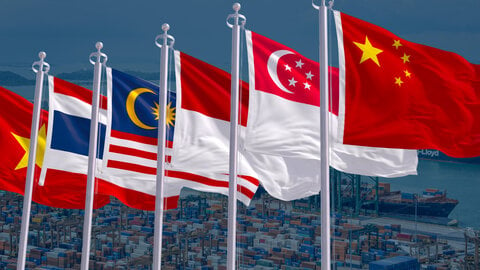
At the same time, the continued shift of chemical production toward Asia is reshaping global supply chains. While China remains the dominant growth engine, many companies are also expanding manufacturing and sourcing activities across the broader APAC region.
Chemical manufacturing networks are becoming increasingly distributed. Rather than relying on a single sourcing market, many producers are expanding operations across China, Vietnam, Malaysia, Thailand, Indonesia and other emerging manufacturing hubs. This creates greater resilience but also adds complexity to transportation and inventory management.
Instead, supply chains increasingly connect manufacturing sites across China, Vietnam, Malaysia, Thailand, Indonesia and other emerging industrial hubs before products reach Europe or North America.
These developments are creating new requirements for Sea Freight, Air Freight, Rail and Contract Logistics. Strategic warehousing, buffer inventories and regional distribution hubs provide companies with greater resilience when production schedules or transportation networks are disrupted.
As a result, logistics providers are increasingly expected to act as strategic supply chain partners, helping customers balance efficiency, resilience, compliance and risk across increasingly complex global networks.
What Comes Next?
The latest data suggests that any recovery in Europe's chemical industry will likely be gradual rather than rapid. While improving confidence indicators may signal that the market has moved beyond its lowest point, the sector continues to face significant structural challenges.
Competitiveness concerns are unlikely to disappear quickly. Energy costs, global overcapacity, regulatory complexity and shifting production footprints will continue to influence investment decisions and manufacturing locations into 2027 and beyond.
Demand remains the key indicator to watch. While inventories have improved and producer sentiment is becoming more optimistic, a sustained recovery ultimately depends on stronger end-market demand across industrial sectors.
At a global level, regional imbalances are expected to persist. China will likely remain the dominant growth engine, while other APAC markets attract manufacturing investment under "China+1" and "China+N" strategies. For global shippers, this means supply chains will become increasingly interconnected across Asia while maintaining strong links to Europe and North America.
For logistics providers supporting the chemical industry, these developments are more than market indicators. They directly influence sourcing strategies, transportation requirements, inventory positioning and supply chain design.
The message from the Cefic report is clear: the industry is not simply waiting for demand to return. Chemical supply chains are being reshaped by shifting production footprints, evolving trade flows and increasing geopolitical and regulatory complexity. Companies that build flexibility, visibility and resilience into their logistics networks today will be better positioned to compete in tomorrow's market.
Chemical Logistics at Leschaco
When markets become more complex, experience matters.
As a logistics provider with deep roots in the chemical and dangerous goods sector, we see many of the trends highlighted by the Cefic report reflected in our day-to-day operations:
- Production locations are changing
- Trade lanes are evolving
- Regulatory requirements continue to expand
At the same time, customers expect greater transparency, flexibility and resilience across their supply chains. This is precisely where specialized chemical logistics creates value.
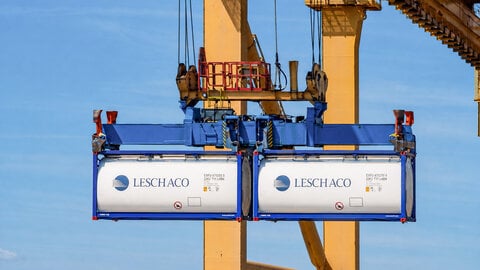
At Leschaco, we combine Sea Freight, Air Freight, Contract Logistics, Tank Containers and multimodal transport solutions with embedded DG compliance and digital visibility to support chemical supply chains across the globe. Whether products move between Europe and Asia, across intra-APAC manufacturing networks, or through regional distribution hubs, integrated supply chain management becomes increasingly important.
We also see growing demand for integrated transport and warehousing solutions. Facilities such as our new Chemical Logistics Hub in Bremen and our established operations in locations such as Moerdijk (NL), Port Klang (MY) and Singapore help customers build additional flexibility into their supply chains. By combining transport, compliant storage and value-added logistics services, companies gain greater control over inventory positioning and responsiveness and risk management.
The chemical industry is entering a period of profound transformation. At Leschaco, our focus remains clear: helping customers navigate growing complexity through safe, compliant and resilient logistics solutions. By combining global reach with specialized chemical and dangerous goods expertise, we support supply chains that can adapt to today's challenges while remaining prepared for tomorrow's opportunities.
At Leschaco, our focus remains clear: helping customers navigate complexity with safe, compliant and resilient logistics solutions, while continuing to combine global reach with the specialized chemical and dangerous goods expertise that has defined our business for more than 140 years.