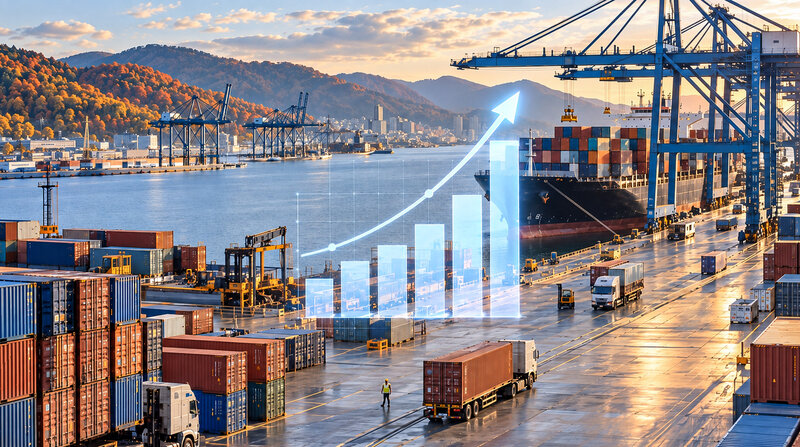




For years, peak season followed a fairly predictable rhythm: Import volumes increased during the summer months as, retailers prepared for Black Friday, Cyber Monday and the year-end holiday season. Carriers added capacity, warehouses filled up and logistics teams prepared for a busy fourth quarter.
In 2026, the situation is more complex.
September is no longer simply the beginning of peak season. It is increasingly becoming the point at which several supply chain pressures converge:
Import demand remains strong across key trade lanes. Trade policy uncertainty has encouraged some companies to bring shipments forward. China’s Golden Week is approaching, prompting many shippers to move cargo ahead of factory and logistics closures. At the same time, typhoon activity can disrupt operations across parts of Asia, while logistics networks continue to adapt to changing trade corridors, regulatory requirements and infrastructure constraints.
The result is not simply a busier peak season. It is a longer period in which higher volumes, operational disruption and uncertainty can occur at the same time.
Peak Season Pressure Extends Beyond Sea Freight
When supply chains come under pressure, Sea Freight typically receives most of the attention, yet focusing only on vessels and containers overlooks the wider logistics network.
Sea Freight: More Volume, Less Room for Error
Sea Freight markets are facing a combination of seasonal and structural pressures.
- Import volumes remain strong across key East-West trade lanes
- Seasonal surcharges are returning in several markets
- Schedule reliability continues to be influenced by operational disruptions
- Weather events across East Asia create congestion and scheduling disruptions
Meanwhile, preparations for October factory closures in China are accelerating cargo flows through already busy ports. At the same time, carriers continue to adjust their network in response to changing operating conditions and security considerations. This creates an increasingly interconnected environment in which disruption in one region can quickly have consequences elsewhere. The key question for shippers is therefore not simply whether capacity exists, but whether the right capacity is available at the right time and on the right route.
Air Freight: A Strategic Alternative Challenges
Air Freight is experiencing its own set of pressure. Demand for higher-value and time sensitive cargo remains strong, particularly in sectors such as technology, electronics and industrial manufacturing.
At the same time, more companies are using Air Freight strategically when Sea Freight schedules become less predictable or production timelines shift.
- But flexibility does not stop at choosing a different mode
- Limited airport and handling infrastructure
- Aircraft and crew availability
- Strong demand for high-value and time-sensitive cargo
- Shifting trade lanes and cargo flows
For critical shipments, air freight can therefore serve as an important complement to ocean transport – particularly when the cost of a delay is significantly higher than the cost of moving cargo by air. But the transport mode is only one part of the equation.
The Challenge Does Not End at the Port
For many supply chains, the journey does not become easier once cargo reaches its destination region. Some of the most significant bottlenecks can emerge after cargo has arrived at the port.
Europe is one example.
As import volumes rise during peak season, pressure can extend into European hinterland networks. Road and Rail capacity can become tighter, while low water levels can restrict inland waterway transport. Terminal congestion and increasing demand for warehouse space can add further strain. Getting a container to Europe is therefore only part of the challenge.
The next questions are just as important:
How quickly can cargo leave the port? Where can it be stored? How easily can inventory be redeployed? And what alternatives are available if the original distribution plan no longer works? Supply chain resilience increasingly depends on the network behind the port:
Supply chain resilience increasingly depends on the network behind the port: the combination of transport modes, infrastructure, warehousing and distribution capabilities that keeps goods moving after they leave the vessel.
The same principle applies in other regions, although the specific constraints differ.
This is particularly relevant for chemical and dangerous goods supply chains. Here, delays, or capacity shortages can can have consequences far beyond a missed delivery window. Compliance requirements, specialized handling and the availability of suitable storage and transport options can directly affect production and customer commitments.
Inventory Positioning as a Resilience Strategy
Companies are increasingly evaluating not only how products move through global transport networks, but also where those products are positioned once they arrive.
Strategically located warehouses, regional distribution centers and flexible logistics networks can provide valuable response time when disruptions occur. Inventory can be repositioned, transport plans can be adjusted, customer commitments can be protected, while bottlenecks are being resolved elsewhere in the network.
In this context Contract Logistics plays a broader role than simply providing storage capacity. Warehousing can become a strategic component of supply chain resilience when inventory visibility, transportation coordination, compliance and distribution are connected.
At Leschaco, this approach is reflected in our contract logistics operations, including strategically located facilities in Moerdijk, the Netherlands and Bremen, Germany. By combining warehousing and inventory management with transportation and distribution capabilities, logistics networks can become more flexible when market conditions change.
Reliability and flexibility can ultimately be more valuable than simply moving cargo as quickly as possible.
Planning for Peak Season Before It Peaks
The companies navigating peak season most effectively are not necessarily those with the most accurate forecasts. They are often the ones with enough flexibility to respond when those forecasts turn out to be wrong.
Planning early helps. So does sharing forecasts with logistics partners before capacity becomes tight. Reviewing alternative gateways, transport modes and distribution points can reveal potential bottlenecks before they become operational problems. Sea Freight will continue to carry the majority of global trade. But for critical shipments, alternatives such as air freight, sea-air, rail, intermodal transport or alternative gateways can provide valuable flexibility. The same applies to inventory. A network built around a single gateway, distribution centre or transport option may perform efficiently under normal circumstances. During peak periods, however, that concentration can turn a local bottleneck into a much larger supply chain issue.
The objective is not to build the most complicated network possible. It is to understand where the critical dependencies are – and have a plan for them before peak season puts them under pressure.
Beyond Peak Season: Building a more robust Supply Chain
Peak season 2026 is a reminder that resilience is not about predicting exactly what will happen next. It is about being prepared for the fact that something will eventually happen differently from what was planned.
At Leschaco, we approach these questions from an end-to-end perspective. FCL, LCL, Air Freight and Intermodal solutions provide different ways to manage international flows. Strategically located warehouses, inventory management and regional distribution add another layer of control, particularly for chemicals and dangerous goods that require specialized handling by experts and reliable compliance processes.
Visibility and communication are equally important. Early forecasts, transparent communication and shipment visibility give teams more time to identify bottlenecks, adjust routes or reposition inventory before delays become critical.
Technology and communication complete the picture. Visibility helps identify issues earlier, while close coordination between shippers and logistics partners makes it possible to act before a delay becomes a larger operational problem.
Ultimately, the strongest supply chains are not those designed around the assumption that everything will go according to plan. They are designed with a clear understanding of where the pressure points are, what can be controlled and how the network can continue to operate when one part of it comes under strain.
That is what makes September more than the start of peak season.
It is a stress test for the entire supply chain.
Peak Season 2026 is putting supply chains to the test on several fronts. Those with flexible logistics setups and dependable partners are better placed to keep cargo moving when plans change.